Parc Monceau, the park at the Camondo’s garden gate
I walk through Parc Monceau most mornings, from Villiers towards the Courcelles gate, and I have stopped noticing the follies, which is what a park is for. Visitors notice them. The park was designed to be noticed: the Duc de Chartres wanted a garden of surprises in the English and picturesque manner, with ruins and colonnades set among winding paths, and from 1778 he got one.
What survives from 1778
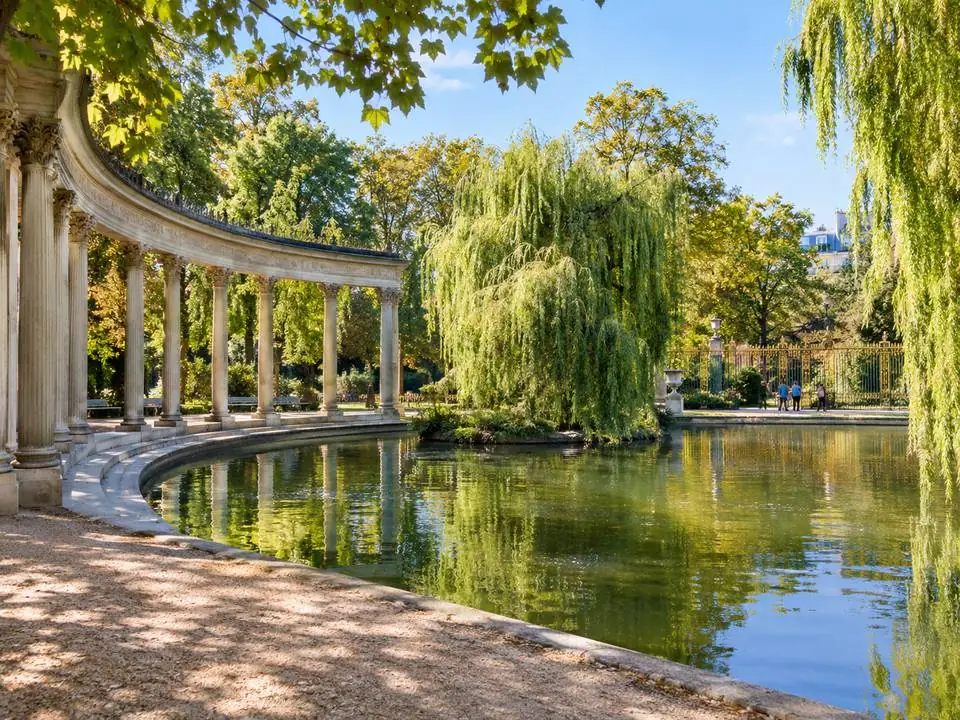
The Naumachie is the piece to find first: a curved colonnade of Corinthian columns reflected in an oval pond, built as a ruin from the start. It is the most photographed thing in the park and deserves to be. Look also for the gilded gates, the fragment of Renaissance arcade brought here from the old Hôtel de Ville, and the statues of Chopin, Maupassant and Gounod, which came later and give the park its 19th-century tone.
1861 and the houses on the edge
When Haussmann redesigned the park in 1861 the land around it was parcelled for building, and the plots on the edge went to the banking families arriving with the Second Empire. The Camondos built at 61 and 63 rue de Monceau in 1869; the Ephrussi at no. 81. Moïse de Camondo’s house of 1911 to 1914 turned its best face to the park, and that face is the one thing about the museum you can still see today. Stand on the path along the south-east side and look for a compact classical pavilion behind railings; the history page explains why it looks like the Petit Trianon.
Ledoux’s rotunda
The rotunda at the boulevard de Courcelles gate, beside Métro Monceau, is by Claude-Nicolas Ledoux. It predates the park’s present form and was one of the tollhouses of the old city wall; the park absorbed it. Enter here if you can, because it is the grandest way in.
The rest of the quarter
The Musée Cernuschi is on the park’s east side, the Jacquemart-André ten minutes south; the full half-day is on the around the museum page. The private Haussmann walk from Opéra finishes in the park, which is why its widget sits below. The best months are April to October, when the gates stay open late.
Frequently asked questions
Can I see the Camondo museum from Parc Monceau?
Yes. The house’s garden opens onto the park and its garden façade, modelled on the Petit Trianon, is visible from the paths on the south-east side. It is the one view of the house available while it is closed.
What is the Naumachie in Parc Monceau?
A curved colonnade beside an oval pond, built as a deliberate ruin when the park was laid out from 1778 for the Duc de Chartres. It is the main survivor of the original garden of follies.
Which Métro is best for Parc Monceau?
Monceau on line 2, which brings you out at the Ledoux rotunda and the boulevard de Courcelles gate. Villiers (lines 2 and 3) is the alternative; the how to get there page compares them.