The Musée Nissim de Camondo, explained
The Musée Nissim de Camondo, at 63 rue de Monceau in the 8th arrondissement, is the house René Sergent built in 1911–1914 for Count Moïse de Camondo on the model of the Petit Trianon, filled with French decorative arts of the Louis XV and Louis XVI years, bequeathed to Les Arts Décoratifs in 1935 on condition that nothing be moved, opened as a museum in December 1936, and closed for restoration since 4 August 2024 with reopening targeted for the end of 2029.
I led group visits through the house for three seasons before it shut, and I still walk past it most mornings on my way through Parc Monceau. The question I am asked most is no longer “what is inside” but “is it really closed”. It is. Here is what that means, what you are waiting for, and what I would do in the meantime.
The closure, with dates
The last visiting day was 4 August 2024. The works cover the interior spaces, the roofs and the façades of a classified Historic Monument, and part of the cost is being raised through a patronage appeal. The first official line was a reopening in early 2027. In summer 2026 the institution moved that to the end of 2029, which some listings round to 2030. A first safety and electrical phase was finished in June 2026; roof works are scheduled to start in May 2027 and the interior décor work in 2028. The wait is dull and I will not pretend otherwise, but a house whose whole point is that nothing has been touched since 1935 cannot be restored with visitors in the rooms. Most of the web has not caught up. The closure page keeps the timeline current.
The house and the bequest
Moïse de Camondo pulled down the house his father Nissim had lived in from 1870 to 1889 and asked Sergent for something that looked like Versailles and worked like 1912: central heating, lifts, modern bathrooms and a professional kitchen wing behind an 18th-century face. He then spent the rest of his life buying the second half of the 18th century for it. Furniture by Oeben, Riesener, Carlin and Georges Jacob; Savonnerie carpets woven in 1678 for the Grande Galerie of the Louvre; Aubusson and Beauvais tapestries; paintings by Vigée Le Brun, Guardi, Hubert Robert and Oudry. When he died in 1935 he left it all to Les Arts Décoratifs in memory of his son, with the request that the house stay as he left it, furniture in place. That request is the museum. You are not walking through a gallery of period rooms assembled by curators; you are walking through a home that stopped in 1935. The history page follows the building from Sergent’s drawings to the opening in December 1936.
Three rooms I would send you to first
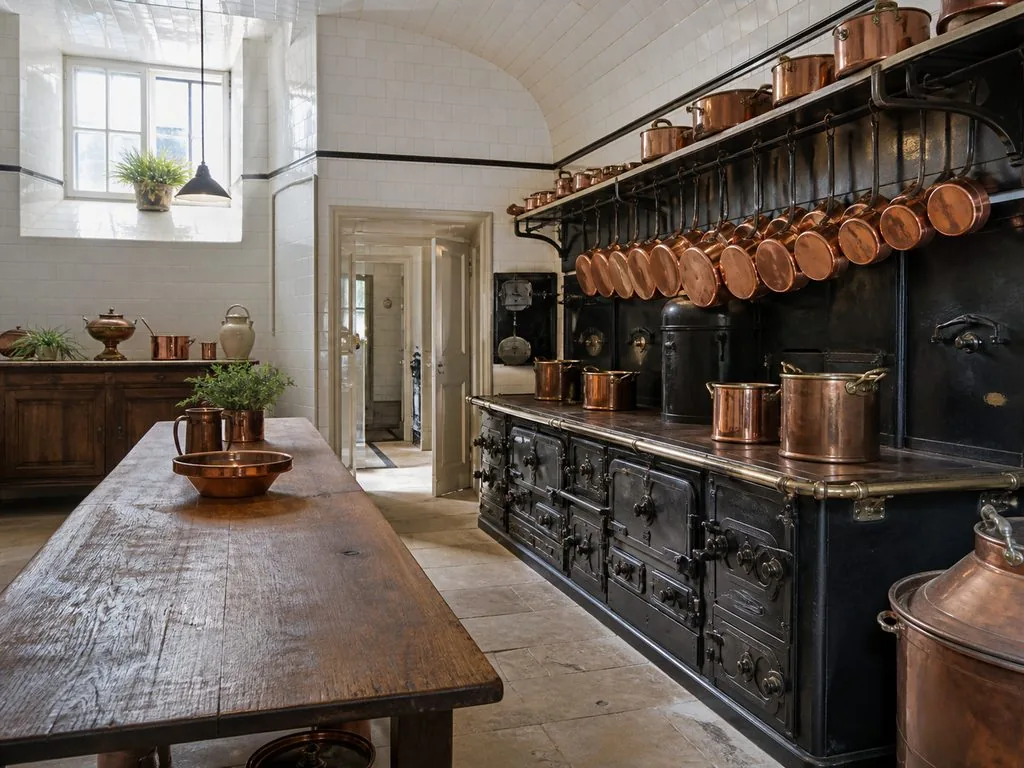
The kitchens, in the lower ground floor, because they explain the rest. A professional kitchen wing, the servants’ dining room, the chef’s office and pantry: the machinery that made the upstairs possible, and the most honest room in the house. Then the Salon des Huet, where Jean-Baptiste Huet’s pastoral panels are set into the walls. Then the Porcelain Room and Dining Room together, for the Sèvres “Buffon” service of the 1780s, each piece painted with a bird after Buffon’s natural history, and the Orloff silver of 1770 that Catherine II of Russia commissioned. Upstairs, Nissim’s own rooms are kept as they were, and the sewing table made for Marie-Antoinette’s private apartments is the piece people ask about afterwards. A full visit took about 1.5 to 2 hours, and arriving ten minutes before the 10:00 opening meant having the rooms nearly to yourself. The what-to-see page goes level by level.
How the family ended
The Camondos were Sephardic Jews expelled from Spain in 1492 who settled in Venice and then in Galata, in Constantinople, where their bank was the leading private bank of the Ottoman Empire until the Imperial Ottoman Bank arrived in 1863. Two grandsons moved the family to Paris in 1869 and built neighbouring houses at 61 and 63 rue de Monceau. One branch gave the Louvre its Impressionists, now mostly at Orsay. The other gave it this house. Nissim, born in 1892, flew reconnaissance in the First World War and was killed in aerial combat near Leintrey on 5 September 1917, aged 25. His sister Béatrice, her former husband Léon Reinach and their children Fanny and Bertrand were deported from Drancy and murdered at Auschwitz in 1943 and 1944. The house was already a museum by then. I could never say that lightly on a visit, and I will not dress it up here. The family page tells the whole arc; Edmund de Waal’s Letters to Camondo, written to Moïse from a few doors up the street, tells it better than I can.
What to do in the quarter now
Stand in front of number 63. Then go into Parc Monceau, which the garden opens onto: laid out from 1778 as a garden of follies, redesigned under Haussmann in 1861, with the Naumachie colonnade and Ledoux’s rotunda still there. The Musée Cernuschi on the park’s east side has free entry to its permanent collection, and the Musée Jacquemart-André, another collector’s mansion, is a ten-minute walk down boulevard Haussmann. April to October is the time to do it, when the park stays open into the evening. The two-hour Haussmann private walk ends at the park after Opéra, Saint-Augustin and Jacquemart-André, and it is the closest thing to a Camondo visit that anyone can book today. If you want 18th-century rooms rather than a street, the same institution’s Musée des Arts Décoratifs on rue de Rivoli is open throughout, with the caveat that visitors expecting furniture find a good deal of fashion and jewellery as well. The around-the-museum page has a half-day plan, and what to book compares the five things I would book myself.
What to book meanwhile
The private Monceau and Haussmann walk is the only tour I know that ends at the park gates a few steps from the house. It is small, warmly reviewed and cancellable up to 24 hours before; the rest of the options are on the what-to-book page.
Frequently asked questions
Is the Musée Nissim de Camondo open in 2026?
No. It closed on 4 August 2024 for a restoration of the interiors, roofs and façades and is expected to reopen at the end of 2029 (some listings say 2030). See the closure page for the timeline.
What is the museum famous for?
French decorative arts of the second half of the 18th century shown inside a lived-in house: the Sèvres Buffon service, the Orloff silver, Savonnerie carpets and furniture by Riesener, Oeben and Jacob — details on what to see.
What can I do near the museum while it is closed?
Walk Parc Monceau, visit the Musée Cernuschi and the Jacquemart-André mansion, or take the Haussmann walk that ends at the park. The half-day plan is on the quarter page.