The history of the Musée Nissim de Camondo
Guides like a house with one clear story, and the Camondo has one: a man built a perfect 18th-century house in the 20th century, lost the son he built it for, and gave it away on condition that nobody touch it. That is true, and I told it for three seasons. The fuller version has a first house on the site, a divorce, an architect with a very particular client, and a set of bathrooms that still surprise people. Here is the fuller version.
The first house at no. 63
The plot on rue de Monceau came into the family in 1869, when the brothers Abraham-Behor and Nissim de Camondo moved from Constantinople to Paris and built neighbouring houses at nos. 61 and 63, on the edge of the newly laid-out Parc Monceau. Nissim lived at no. 63 from 1870 until his death in 1889; his brother died the same year. Their story before Paris, and the bank behind the money, is on the Camondo family page. Nissim’s son Moïse inherited the house and, in time, decided it would not do.
René Sergent and the Petit Trianon
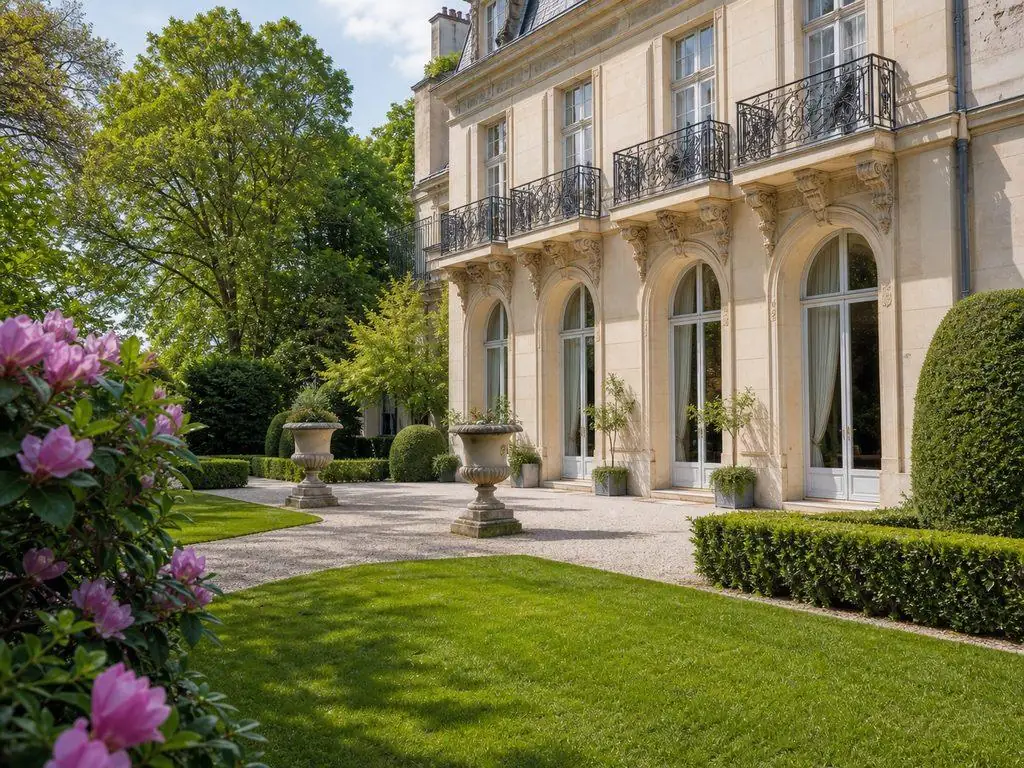
Moïse de Camondo had been collecting French decorative art of the second half of the 18th century for years by 1911, and his father’s house was the wrong shape for it. He demolished it and commissioned René Sergent, an architect who knew how to make a new building look like an old one without embarrassment. The model they settled on was the Petit Trianon at Versailles: a compact, symmetrical pavilion with a garden front, scaled to a family rather than a court. Work ran from 1911 to 1914. Stand on the garden side of the park and the debt is obvious; stand in the courtyard and it is subtler, because the street front has to cope with a Paris plot and a service wing.
A modern house behind an old face
This is the part visitors do not expect. Behind the Louis XVI proportions Sergent installed central heating, lifts, modern bathrooms and a professional kitchen wing of the kind a good restaurant of 1914 would have recognised. The count wanted to live among his collection, not in a museum of it, and he wanted to live comfortably. The lower ground floor with its kitchens, servants’ dining room and chef’s office is, to my mind, the most honest room in the house, and I describe it with the rest on the what to see page.
1917
Moïse had married Irène Cahen d’Anvers in 1891; the marriage ended in divorce, and he raised the two children, Nissim and Béatrice, in the new house. Nissim, born in 1892, flew reconnaissance missions in the war and was killed in aerial combat on 5 September 1917 near Leintrey in Meurthe-et-Moselle, at 25. He had been the heir to the house and, one assumes, to the collecting. There is a page on Nissim de Camondo; here it is enough to say that the house changed purpose that autumn, even if nothing in it moved.
The bequest of 1935
Moïse de Camondo died in 1935. His will left the house and everything in it to Les Arts Décoratifs, to be opened as a museum in his son’s name, on the condition that it stay as he had left it, furniture in place. That condition is the reason the Camondo is unlike the other decorative-arts collections in Paris. Nothing is behind glass in a numbered case; the Sèvres service is in the dining room because that is where a dinner service goes, and the chairs stand where people sat. The museum opened in December 1936. The daughter, Béatrice, saw it open; what happened to her and her children eight years later is on the family page, and it is why the house is the only monument the Paris Camondos have.
1936 to 2024
For nearly ninety years the museum did what the will asked. Generations of Parisians walked through a home rather than a gallery; the Netflix series Lupin borrowed it as the Pellegrini family house; Edmund de Waal, whose own family had lived a few doors up at no. 81, addressed a book of letters to Moïse. Then on 4 August 2024 the doors closed for a restoration of the interiors, roofs and façades, with reopening now targeted for the end of 2029. The closure page has the schedule.
If you read one thing before the house reopens, read the will. Not the whole document, but the condition: keep it as I left it. Every room makes more sense once you know the owner wrote that sentence with his son in mind.
Frequently asked questions
Who built the Musée Nissim de Camondo?
The architect René Sergent, for Count Moïse de Camondo, between 1911 and 1914. It replaced the house Moïse’s father Nissim had lived in from 1870 to 1889 on the same plot. More on the client on the Moïse de Camondo page.
Is the house a copy of the Petit Trianon?
It is modelled on it rather than copied from it: the same compact pavilion form and garden front, adapted to a Paris plot with a service wing, and fitted with central heating, lifts and modern bathrooms. The garden façade, seen from Parc Monceau, shows the resemblance best.
Why is it called the Musée Nissim de Camondo and not Moïse?
Because Moïse asked that it be. His son Nissim was killed as a pilot on 5 September 1917, and the 1935 bequest created the museum in his memory. See the page on Nissim.
When did the museum open?
In December 1936, a year after Moïse de Camondo’s death. It stayed open until 4 August 2024 and is now closed for restoration; the closure page gives the timeline to the end of 2029.