Le Marais and Montmartre Jewish history walking tour review
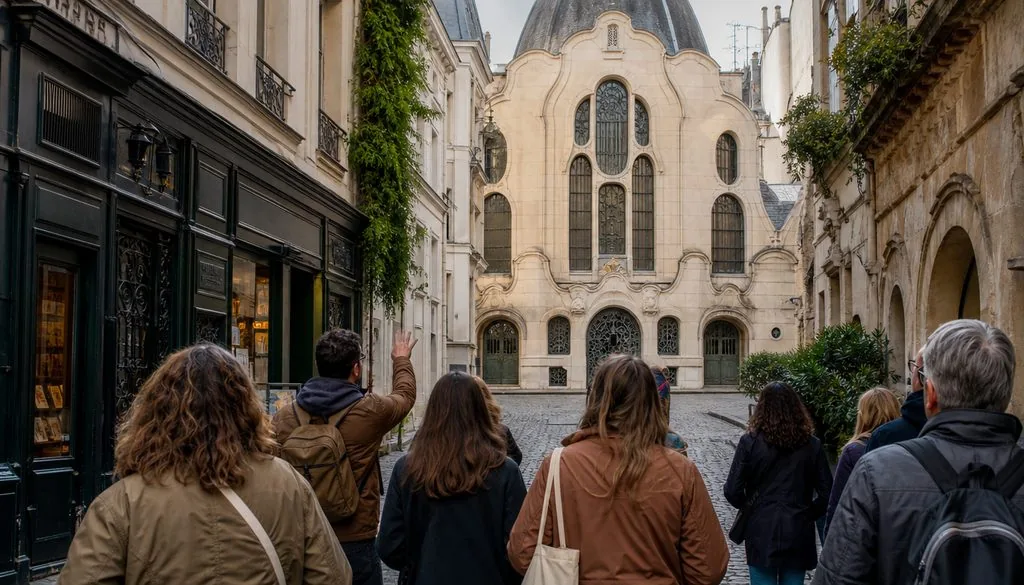
My verdict: the walk I recommend to anyone who read about the Camondo family and wanted the rest of the story. Three and a half hours, a group of nine at most, in English, from the Marais to Montmartre by public transport with the tickets included. It rates 4.9 from 178 reviews, and almost every one of those reviews is about the guide. It does not go to rue de Monceau. What it does is put the deportation of Béatrice de Camondo and her children into the Paris that surrounded it, standing outside the Shoah Memorial, and that is a context the house itself never had room to give.
What it is
Two neighbourhoods in one afternoon. In the Marais: the Agoudas Hakehilos synagogue on rue Pavée, Hector Guimard’s Art Nouveau synagogue, visited inside where possible; the exterior of the Shoah Memorial; the courtyards of the Village Saint-Paul; and the streets around rue des Rosiers. Then public transport, tickets included, to Montmartre for rue Ravignan and the Bateau-Lavoir, the exterior of the Musée de Montmartre, and an end at Sacré-Cœur. The group meets at L’Éléphant du Nil bar by Métro Saint-Paul, and the listing asks you to arrive fifteen minutes early. It is not suitable for wheelchair users.
The Camondo connection is the family, not the house. The Camondos were Sephardic Jews who left Constantinople for Paris in 1869 and built on the Monceau plain, a long way in every sense from the Marais. But the end of the family happened in the same city and the same years this walk describes: Béatrice de Camondo, her former husband Léon Reinach and their children Fanny and Bertrand were deported from Drancy and murdered at Auschwitz between 1943 and 1944. The names are recorded at the Shoah Memorial. The Camondo family page tells the whole arc from 1492 to 1944; this walk is where you stand in front of it.
Usually included
- Guide, in English, for about 3.5 hours
- Public transport tickets between the Marais and Montmartre
- Indoor visit of the Agoudas Hakehilos synagogue where possible
- Exterior of the Shoah Memorial, Village Saint-Paul, rue des Rosiers
- Rue Ravignan, Bateau-Lavoir, Musée de Montmartre exterior, Sacré-Cœur
- Free cancellation up to 24 hours before
Not included
- Entry to the Shoah Memorial or the Musée de Montmartre
- Food and drink
- Wheelchair access — the listing says not suitable
- Anything on rue de Monceau; the Camondo house is closed and off this route
What the reviewers say
One hundred and seventy-eight reviews and a run of guides’ first names, which tells you what people are rating. Amy, from the United States: “Thomas was an excellent guide, very knowledgeable about Jewish history in Paris.” Barbara, from France: “Pierre-Louis was amazing, so knowledgeable and engaging.” Noam, from the United States: “Benjamin was an excellent guide.” Stacey, from Australia, found it “super informative, personable”.
Two reviews say more than the rest. David, from the United States, wrote that the guide “really knows the history of the area and deals with sensitive issues”, which is the skill this subject needs and the one I would want to know about before booking. Linda, from the United States, mentioned that the guide kept the group focused despite the weather, which is a reminder that three and a half hours is a long time outdoors in February. Dress for it.
What works
- Nine people at most, so the sensitive parts stay conversational
- Guides who, by the reviews, handle the Shoah material with care
- Transport between the two quarters is included, not left to you
- Guimard’s synagogue inside where possible, which is rare
Worth knowing
- Three and a half hours on foot and on the métro; not for tired days
- Not suitable for wheelchair users
- The Shoah Memorial is seen from outside; go back on your own for the interior
- No Camondo stop — the family is context here, not the subject
Do this walk before you read Letters to Camondo, not after. De Waal’s book assumes you already know what happened to Béatrice, and the guide on rue Pavée will make sure you do.
Who should book it
Anyone whose interest in the Camondo is the family rather than the furniture. People who came to Paris for its Jewish history and want one afternoon that covers two neighbourhoods. Readers of de Waal.
Who should skip it: anyone with limited mobility, or with only two hours, who should look at the shorter Marais walk instead; and anyone whose real want is the Monceau quarter and the house, for whom the Haussmann walk is the honest match. For the biographies before you go, Nissim and Moïse each have a short page.
Other listings to consider
 2 hours
Paris: Jewish Heritage & Hidden Gems of Le Marais
 Passes Parc Monceau
Haussmannian Paris 2-Hour Private Walking Tour
 Same institution
Paris: Museum of Decorative Arts Ticket and City Audio Tour
Frequently asked questions
Does this tour visit the Musée Nissim de Camondo?
No. It covers the Marais and Montmartre, and the Camondo house on rue de Monceau is in any case closed until the end of 2029. The connection is the family: Béatrice de Camondo and her children were deported from Drancy and murdered at Auschwitz, and the walk stops outside the Shoah Memorial where such names are recorded. The family page has the full story.
How physically demanding is it?
Three and a half hours, mostly on foot, with a public-transport hop between the Marais and Montmartre (tickets included) and a climb at the Sacré-Cœur end. The listing says it is not suitable for wheelchair users. The two-hour Marais walk is the gentler option.
Where do we meet?
At L’Éléphant du Nil bar next to Métro Saint-Paul, fifteen minutes before the start time. Groups are capped at nine. Cancellation is free up to 24 hours before, and live dates are in the availability widget.